
Last updated October 15, 2026
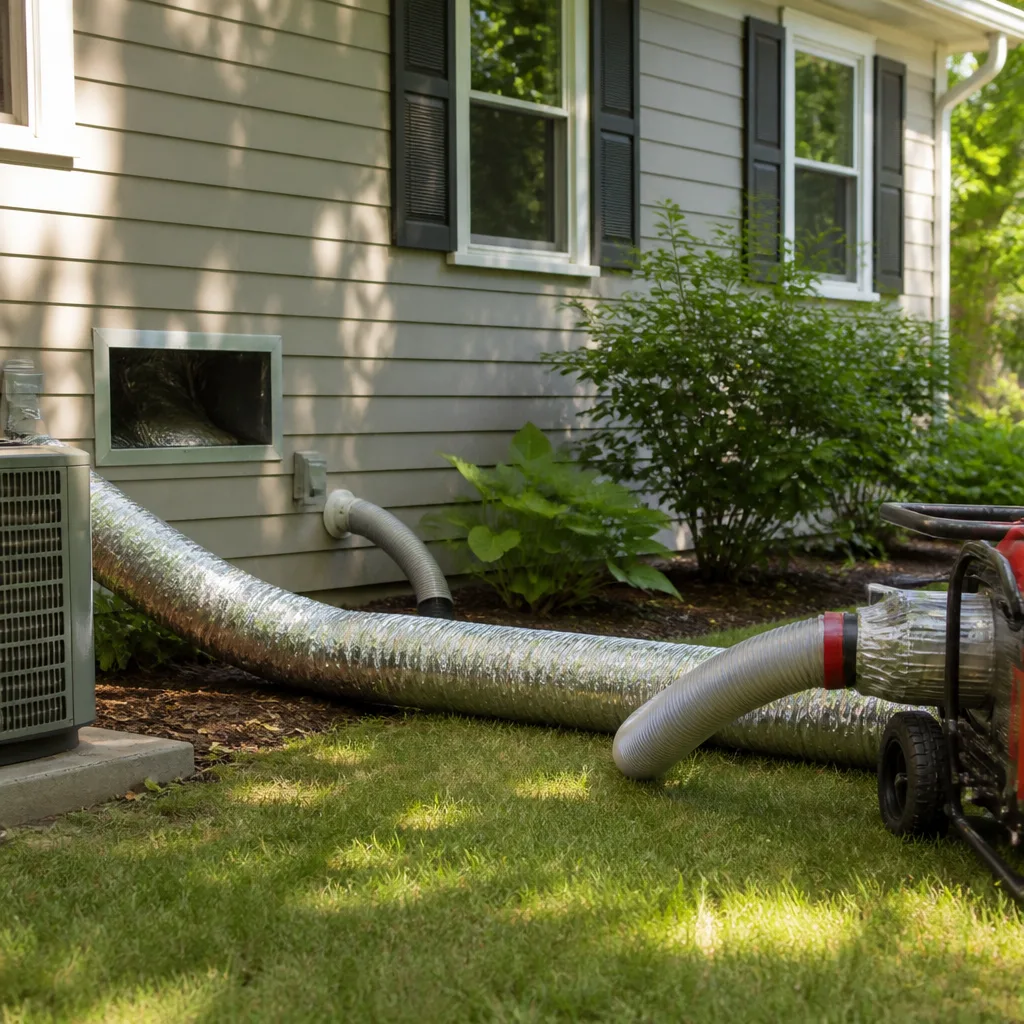 Whole-home duct cleaning
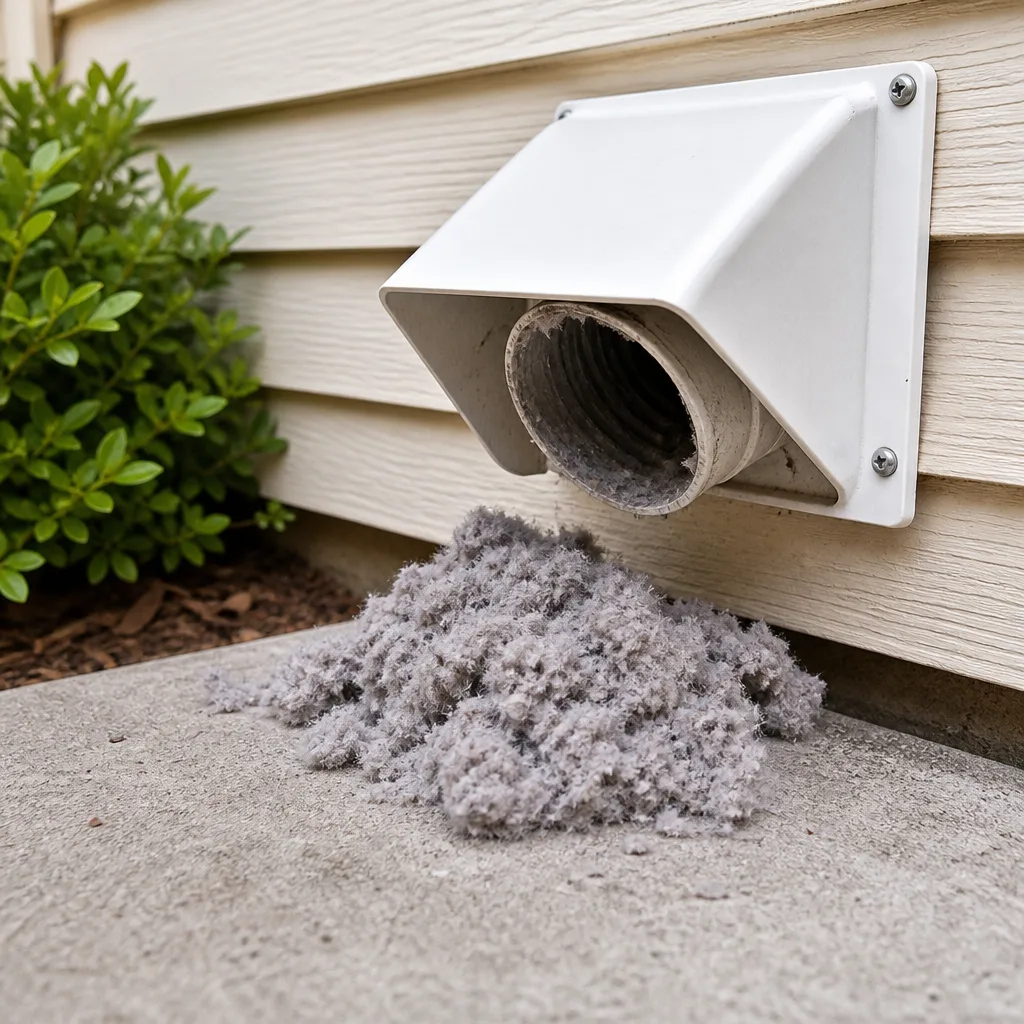 Dryer vent cleaning
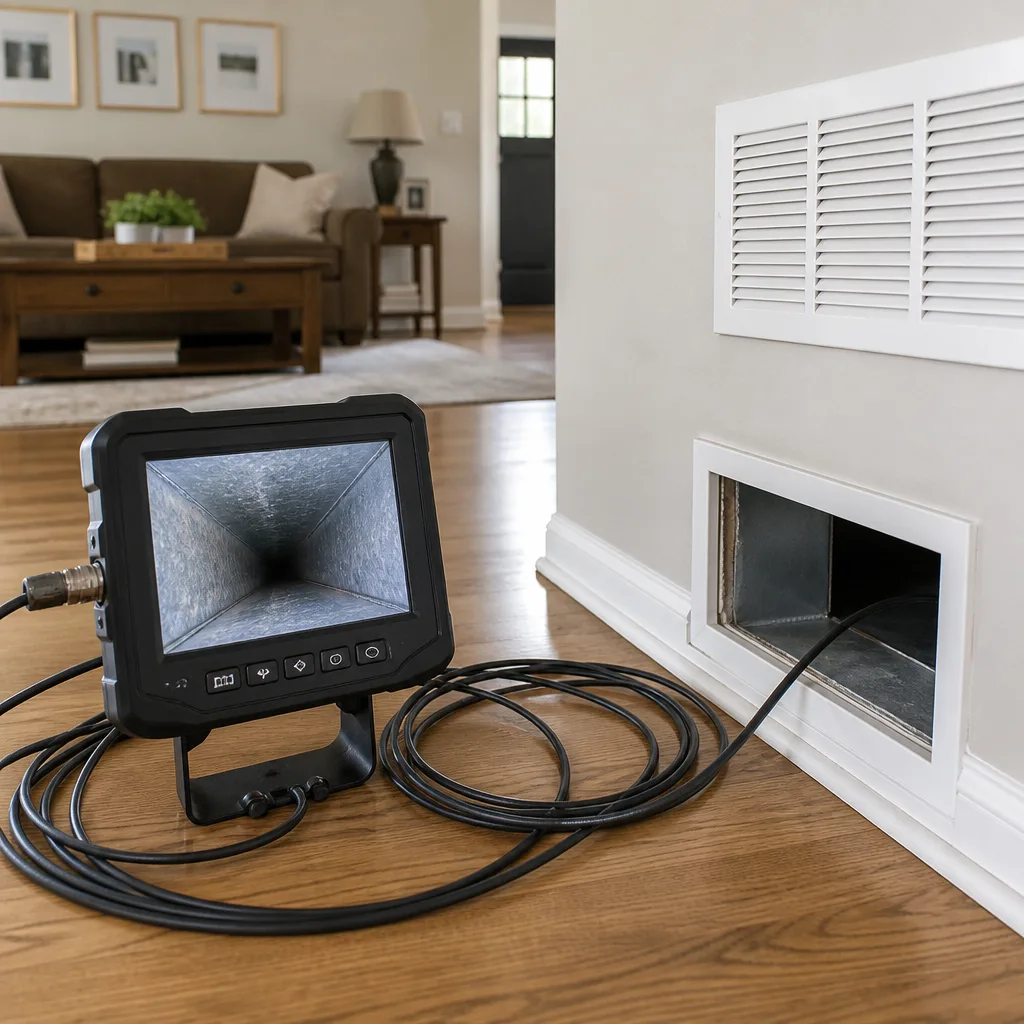 Camera inspection
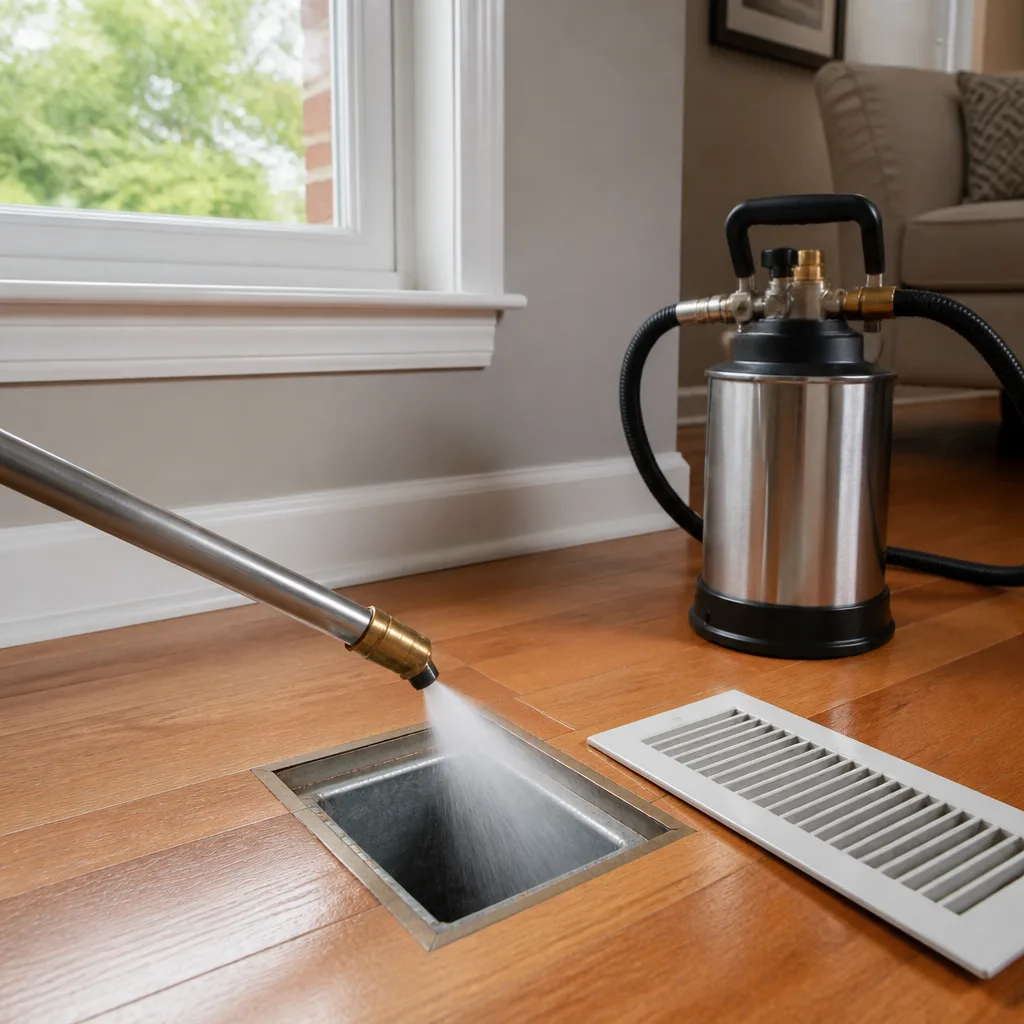 Sanitizing & deodorizing
Whole-system duct and dryer vent check with before-and-after photos - you see exactly what came out of your vents
That "$99 whole-house special" is a bait ad - the real number appears once they are in your hallway, or the "clean" is a shop-vac at the register. We photograph the inside of your ducts before and after instead.
DIY vs Professional Air Duct Cleaning: The West Palm Beach Homeowner’s Decision Guide
Here’s the counterintuitive truth we’ve learned after two decades in West Palm Beach homes: the moment you decide to clean your own air ducts, you’re not really deciding between cleaning methods. You’re deciding what part of the system you can actually reach. A shop vac and a brush kit will absolutely remove the dust you can see at the register. But in a typical West Palm Beach home, the visible registers represent maybe ten percent of the total interior surface area of your ductwork. The other ninety percent, the trunk lines, the bends, the return plenum, sits sealed inside walls, ceilings, and attics where the afternoon sun bakes the air inside to well over 100 degrees six months a year. This guide maps exactly what you can reach from the outside, what you cannot, and the three questions that tell you which side of the DIY-versus-professional Air Duct Cleaning services line your home actually falls on.
Quick Answer
DIY air duct cleaning in West Palm Beach is genuinely effective for one task: keeping your visible registers, return grilles, and the first few inches of branch ducting free of loose surface dust and pet hair between professional cleanings. It is not a substitute for professional cleaning when the contamination sits in the trunk lines, air handler, evaporator coil, or return plenum, which is where most West Palm Beach systems actually collect debris. The honest deciding factors are what’s inside your ducts, not how much you’d like to save, and a professional negative-pressure extraction typically runs $450 to $800 for a full single-family system in Palm Beach County.
Styles & brands we work with
Table of Contents
- What DIY Cleaning Can Physically Reach (and What It Can’t)
- Why West Palm Beach Ducts Get Dirtier Than Most
- The Equipment Gap: Consumer Tools vs. Negative-Pressure Extraction
- The Four Conditions That Rule Out DIY Entirely
- DIY Maintenance Between Professional Cleanings, Done Right
- The Three-Question Decision Framework
- What Each Path Actually Costs in West Palm Beach
- Common Mistakes to Avoid
- When to Call a Professional
- Frequently Asked Questions
What DIY Cleaning Can Physically Reach (and What It Can’t)
Let’s talk about the geometry of your duct system, because understanding this one concept changes how you think about DIY cleaning. A standard West Palm Beach single-family home has a system shaped like a tree. The trunk is the main supply line running from the air handler. The branches are the smaller ducts that split off to each room. The leaves are your registers, the metal or plastic grilles you can see and touch.
Your DIY tools, a shop vac, a register brush, a dryer vent cleaning kit, reach the leaves and, at best, the first twelve to eighteen inches of each branch. In a typical 2,000-square-foot home with ducts running through a hot attic, here’s what that actually covers:
- Supply registers: Fully reachable. You can remove the grille, vacuum the visible duct opening, and wipe the grille itself clean.
- Return grilles: Fully reachable at the face, partially reachable a foot or two inside. Return ducts pull air in, so they collect a disproportionate amount of lint, dust, and pet hair.
- Branch ducting (the first 18 inches): Partially reachable with a flexible vacuum hose and a rotating brush attachment.
- Trunk lines (the main supply and return arteries): Not reachable. These run through walls, chases, and attic spaces, often 20 to 40 feet long, with hard bends at the plenum connections.
- Air handler interior, evaporator coil, blower wheel: Not reachable. This is the heart of your AC system, and in West Palm Beach, it’s where condensation, dust, and biological growth converge.
- Return plenum (the box where return air collects before crossing the filter): Not reachable. This is often the dirtiest cavity in the entire system.
Here’s the point that’s easy to miss: the parts you cannot reach are precisely the parts that move the most air. Air doesn’t spend much time at the register. It spends its entire journey moving through the trunk, past the coil, across the blower, and through the plenum. If there’s contamination in those cavities, your DIY effort removed dust from the least consequential surfaces in the system.
We’ve also seen a specific failure pattern in West Palm Beach homes that’s worth naming. When a homeowner runs a powerful shop vac into the first few inches of a supply register, they stir up fine particulate that was resting in the branch. Some of that particulate gets vacuumed. Some of it gets pushed backward into the branch, beyond the reach of the hose. Then the system kicks on, and that loosened debris ends up deposited across the coil or blown through the living space. The register looks cleaner, and the system is now slightly dirtier where it matters. DIY cleaning without negative pressure on the system can redistribute debris. That’s not a sales line; it’s physics.
Why West Palm Beach Ducts Get Dirtier Than Most
West Palm Beach has two environmental realities that most national duct cleaning advice doesn’t account for. The first is humidity. The second is the tourist-and-snowbird occupation pattern. Both of them matter more than most homeowners realize.
Indoor humidity in West Palm Beach runs between 55% and 70% for most of the year, often higher in homes with older envelope construction in neighborhoods like Flamingo Park, Grandview Heights, or the El Cid historic district. What does humidity do inside a duct? It makes dust sticky. Fine particulate that would blow through a dry system in Arizona or Nevada instead adheres to the interior walls of your ductwork, where it builds up in layers. It also creates the moisture conditions that allow dust to support mold growth on duct interiors, especially in the return side where condensation is common. If you’ve ever noticed a musty smell when your AC first kicks on in the morning, that’s the classic West Palm Beach signature of moisture-bound debris in a return duct.
The second factor is seasonal vacancy. Thousands of homes in West Palm Beach sit empty from April through October while their owners are up north. During those months, many systems are run only enough to keep mold at bay, or shut down entirely. Dust settles. Humidity does its work. Over years, a seasonal home accumulates the same duct debris load as a year-round home, but in a denser, more compacted layer that’s harder to remove with surface tools. If you bought a previously seasonal home and the ducts have never been professionally cleaned, you’re likely dealing with years of compacted contamination, not the light surface dust of a continuously occupied home.
Linden Air Duct West Palm Beach sees this pattern all the time in the older waterfront neighborhoods along Flagler Drive, where mid-century homes have original or decades-old ductwork. The question isn’t whether those ducts have debris. It’s how deep it goes and whether it includes biological growth from decades of humidity cycles.
The Equipment Gap: Consumer Tools vs. Negative-Pressure Extraction
Let’s be precise about what professional equipment does differently, because once you understand the mechanism, the price difference stops looking arbitrary. The benchmark professional method is called negative-pressure extraction. It’s the standard that organizations like NADCA (the National Air Duct Cleaners Association) have described for decades.
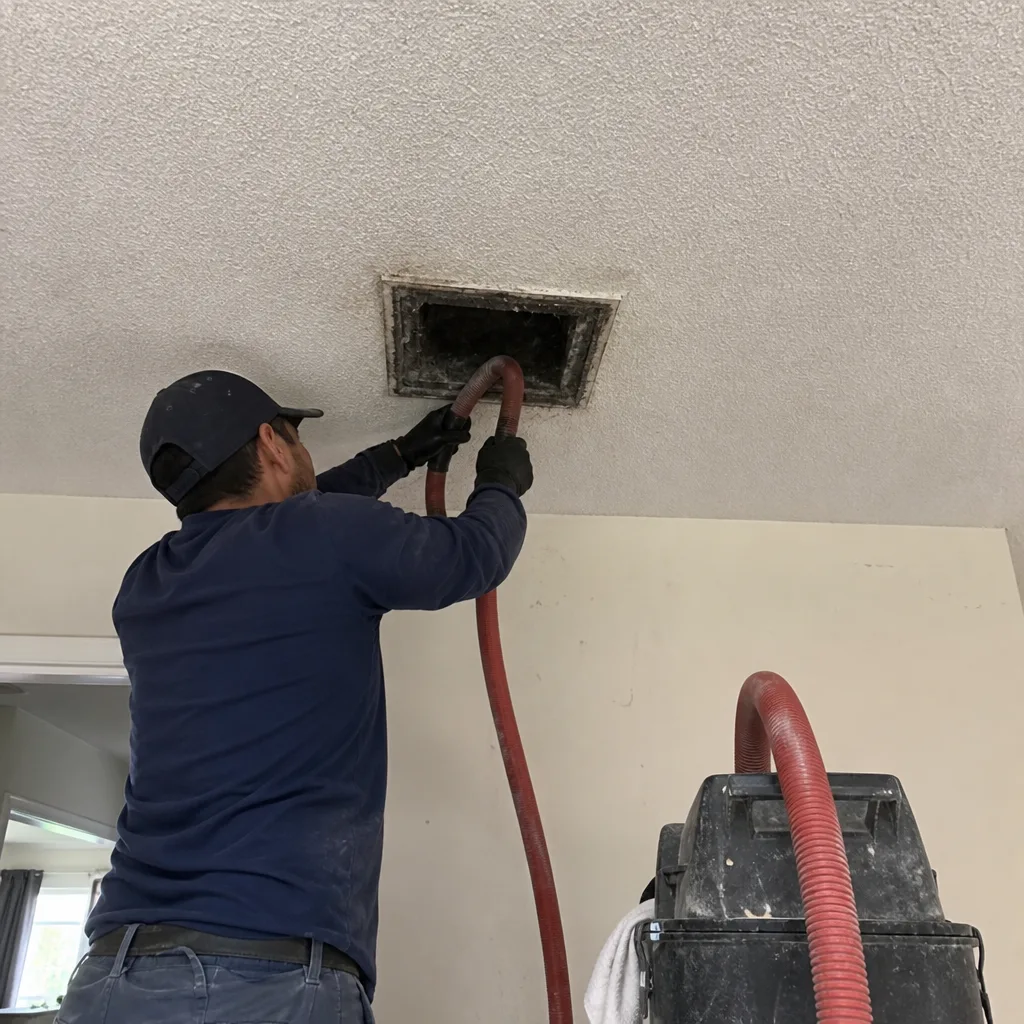
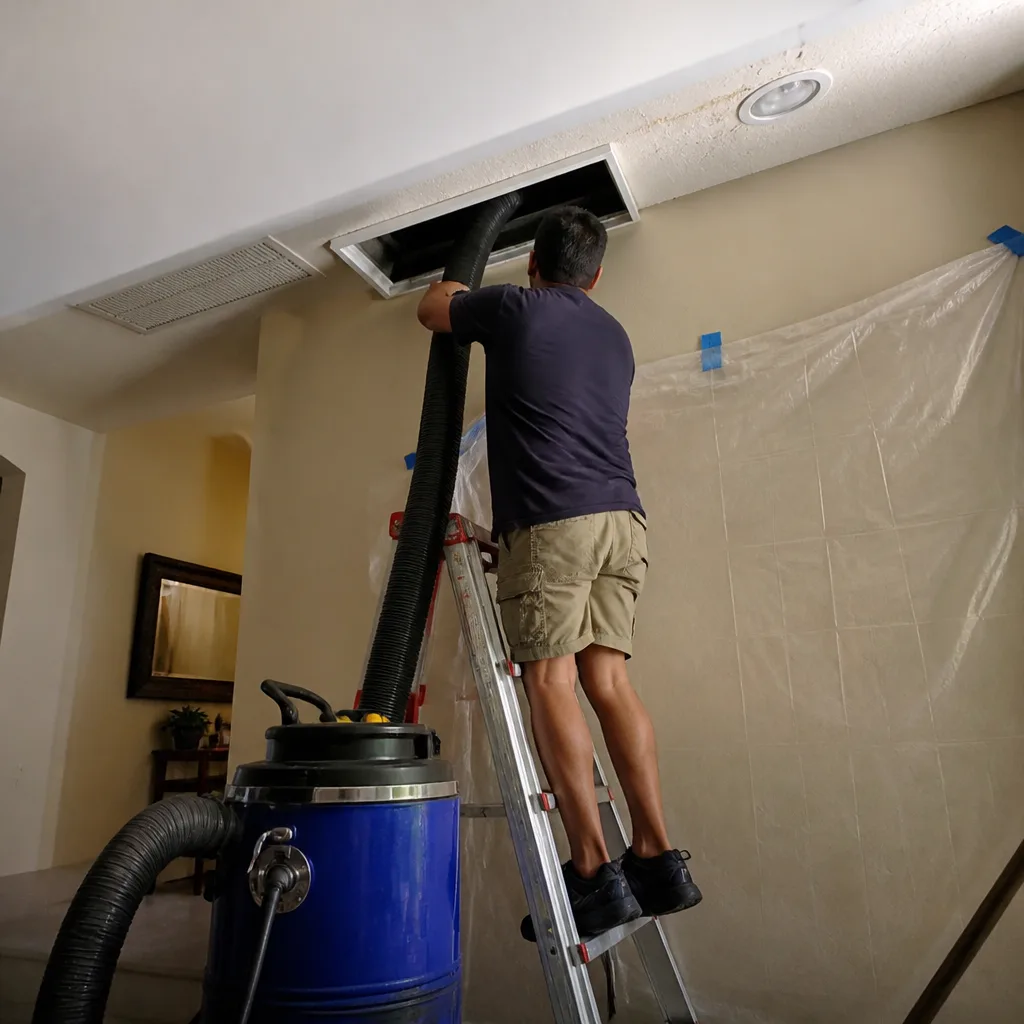
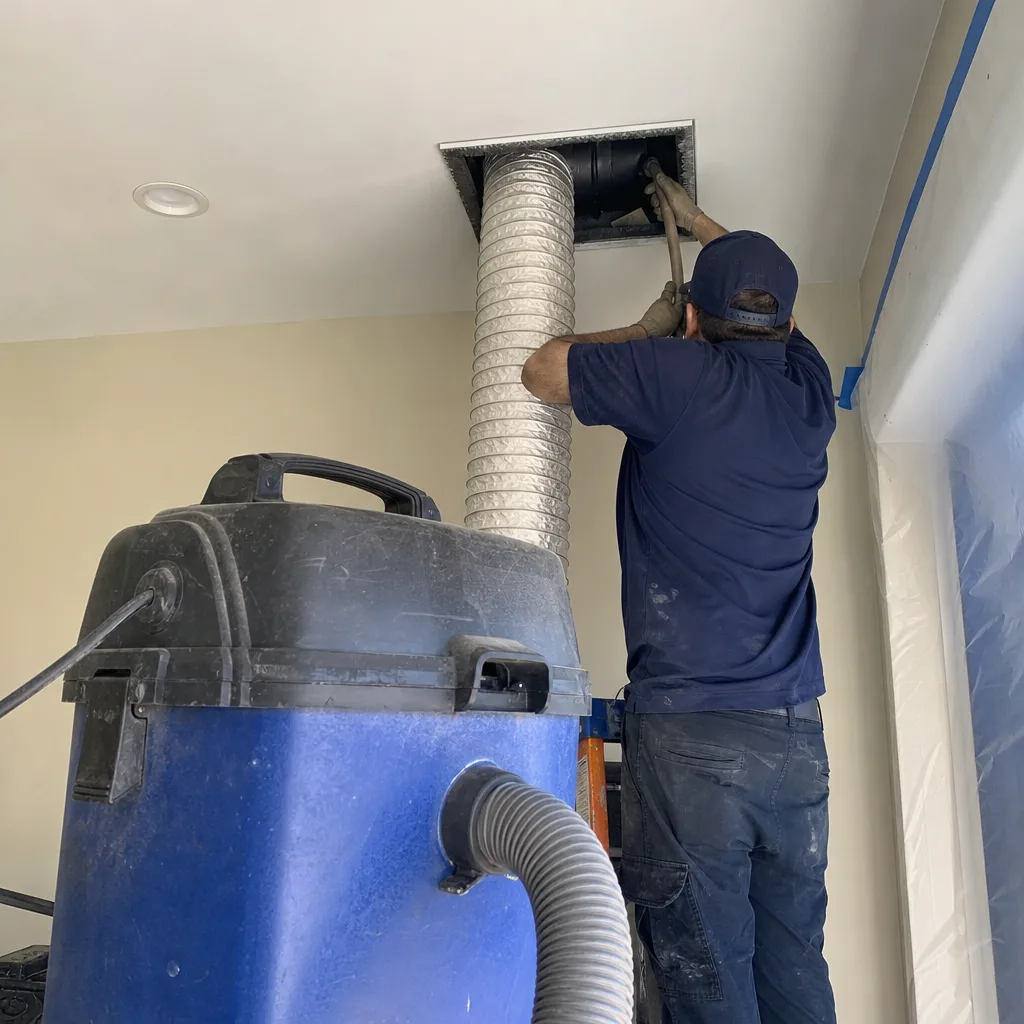
Here’s the principle: instead of blowing air into the ducts and hoping debris flies out through the registers, negative-pressure equipment attaches a high-powered vacuum to the main trunk line and pulls the entire duct system into a state of negative pressure. Inside that negative pressure, a technician runs agitation devices, rotating brushes, compressed-air whips, snake tools, through the ducts. The debris gets dislodged from the walls and immediately pulled toward the vacuum. Nothing escapes into the living space, because air is moving into the ducts at every opening, not out of them.
Your shop vac works in the opposite direction. It’s a point vacuum. It creates suction only at the tip of the hose. It exerts no negative pressure on the trunk lines, the plenum, or the air handler. It cannot create the carrier-air velocity needed to pull compacted debris from a 30-foot trunk line through a wall cavity.
The equipment used by Air Duct Cleaning in West Palm Beach performed by a professional company typically includes:
- A high-CFM negative air machine rated at 2,000 to 5,000 cubic feet per minute, enough to move air through the entire duct volume simultaneously.
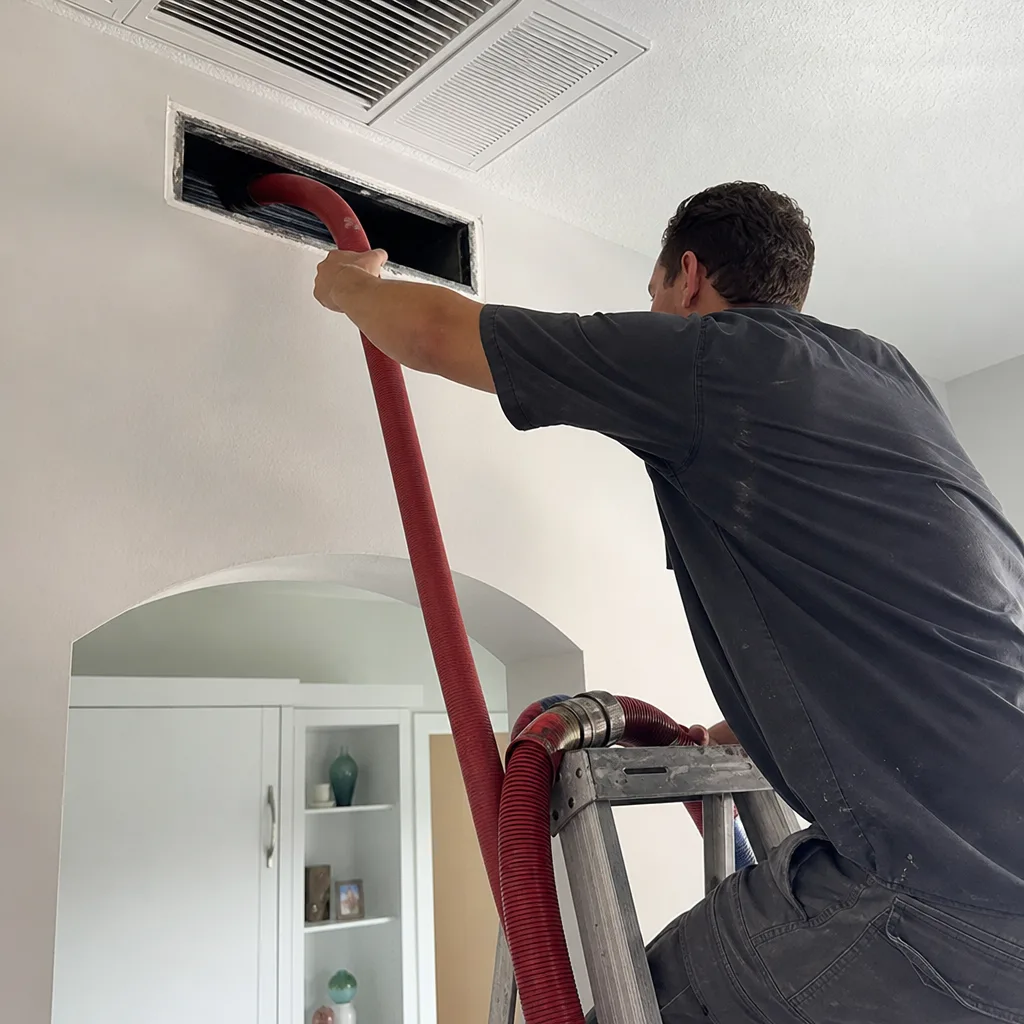
- Rotary brush systems from brands like Rotobrush or Nikro that mechanically scrub the duct interior walls while the negative pressure carries debris away.
- Compressed-air agitation tools with skipper nozzles that bounce through the duct at high pressure, dislodging caked debris without damaging the duct seams.
- HEPA-filtered vacuum units that capture particulate down to 0.3 microns instead of exhausting it back into your home, which matters when you’re dealing with mold spores or fine pest debris.
- Inspection cameras run through the duct after cleaning to verify the walls are actually clean, not just the registers.
A Rotobrush or Nikro system doesn’t just reach farther than a shop vac. It creates a fundamentally different mechanical action: scrubbing plus simultaneous extraction. The distinction matters because compacted Florida dust, the kind that’s been baked onto duct walls through repeated humidity cycles, does not respond to suction alone. It responds to mechanical agitation. And the only safe way to agitate a sealed trunk line is under negative pressure, which requires equipment no consumer tool provides.
The Four Conditions That Rule Out DIY Entirely
There are situations where attempting DIY duct cleaning isn’t just ineffective; it’s actively counterproductive. Here’s our honest practitioner’s list. If any of these apply to your home, skip the shop vac and start with a professional assessment.
1. Visible mold growth in or around the ducts
If you can see fuzzy, dark, or greenish growth on the interior of a supply register, on the return grille, or on the fiberglass insulation inside the air handler, you’re not dealing with dust. You’re dealing with a biological contaminant. Disturbing mold with a brush or vacuum spreads spores into the airstream, where they’ll find new moisture sources and start new colonies. Professional mold remediation in ductwork requires containment, HEPA extraction, and often antimicrobial treatment with products designed for HVAC systems, like those from Abatement Technologies. This is not a surface-cleaning problem. It’s a contamination problem with a specific protocol.
2. Pest intrusion in the ductwork
Palmetto bugs, rodents, and geckos all find their way into West Palm Beach duct systems, especially in crawl-space and attic installations. If you hear scratching, find droppings at the registers, or smell a persistent animal odor when the AC runs, the problem is not just the pest. It’s the nest material, the waste, and the risk of bacteria those leave behind. Agitating pest-contaminated ducts without full extraction and sanitation sends aerosolized waste particles into your living space. Professional cleaning includes removal of the biological debris and sanitization of the duct interior, and often the repair work that closes the entry point.
3. Post-renovation construction debris
West Palm Beach has a constant renovation cycle: the 1920s Spanish Revival homes in El Cid, the 1950s ranches in Forest Hill, the 1970s and 80s builds in the western neighborhoods. If your home recently went through drywall work, flooring replacement, or any sanding-heavy project, your ducts are now holding construction dust, which is finer, heavier, and more abrasive than the organic dust a shop vac is designed to collect. Drywall dust in particular coats the evaporator coil and reduces system efficiency, and it requires the agitation-plus-extraction combination to remove properly. DIY attempts will not clear it from the coil or trunk.
4. System-wide odor that persists after register cleaning
This is the condition that sends homeowners on a long, frustrating cycle of DIY attempts. They clean every register. They replace the filter. They run deodorizing sprays. The smell returns within days. What they’re experiencing is odor sourced deep in the system: a mold colony on the coil, a pest nest in the return plenum, or compacted debris in the trunk line that holds moisture and re-releases odor every time the AC cycles. Surface cleaning cannot fix this because the source isn’t at the surface. If you’ve cleaned your registers and the smell persists, the useful information is not that you failed at DIY. It’s that the source is beyond DIY reach, and continuing to scrub registers will keep redistributing whatever is decomposing in the plenum.
DIY Maintenance Between Professional Cleanings, Done Right
Here’s where DIY has a legitimate, genuinely useful role. Between professional cleanings, usually scheduled every three to five years for most West Palm Beach homes, or every two to three years if you have pets, dust-generating hobbies, or a seasonal home, there’s a simple maintenance protocol that improves air quality without overstepping what consumer tools can safely do. For Seasonal Air Duct Cleaning Care for West Palm Beach: Year-Round Homeowner’s Guide, adjust this interval accordingly.
The Correct DIY Maintenance Routine
- Turn the HVAC system off at the thermostat. This prevents the blower from cycling while you’re working and eliminates the risk of a tool getting pulled toward the return.
- Remove each supply grille and return grille. Most are held by two Phillips screws. Set the screws aside in a small cup so you don’t lose them.
- Vacuum the visible duct opening with a brush attachment on a shop vac. This captures the loose dust, pet hair, and surface debris at the first six to twelve inches. Do not force the hose deeper than it naturally reaches. Forcing it is how you dislodge debris you can’t extract.
- Wash the grilles themselves with warm soapy water. Let them dry completely before reinstalling. A damp grille will catch dust faster.
- Replace the air filter. In West Palm Beach, if you run your AC year-round, a 1-inch pleated filter should be checked monthly and replaced every 60 to 90 days. A clogged filter is the single biggest driver of coil contamination.
- Vacuum around the return grille area and any accessible vent openings. This reduces the material that gets pulled into the system when the blower cycles.
This protocol takes about 45 minutes in a typical West Palm Beach home and will not damage your ductwork or void any HVAC warranty, provided you stop where your tools naturally stop. The warranty risk comes from aggressive DIY: shoving improvised tools into the duct, pulling out insulation, or separating duct sections at the joints. Most HVAC manufacturers require professional service records for warranty claims related to the air handler or coil, and evidence of amateur duct modification is a quick way to get a claim denied.
For Dryer Vent Cleaning in West Palm Beach, the same principle applies. You can vacuum the lint trap housing and the first few inches of the vent pipe behind the dryer. You cannot reach the vent run through the wall or the termination at the roof or eave, and that’s where the majority of lint accumulation and blockage risk sits. Lint is far more flammable than most homeowners realize, and the section you can’t see is the section that matters for fire prevention.
The Three-Question Decision Framework
Here’s the practical tool this guide has been building toward. Ask yourself these three questions in order. By the time you finish the third, you’ll know which path your home actually needs.
Question 1: What am I actually trying to solve? Be honest about the problem. Are you trying to reduce visible dust on furniture between cleanings? That’s a filter-and-hygiene problem, and DIY register maintenance plus better filtration is a legitimate answer. Are you trying to eliminate a persistent odor? A musty smell? Reduced airflow from certain registers? Those are system-level problems, not register-level problems, and DIY cannot reach them. If the problem statement is “my house is dusty and I want to do something useful this weekend,” DIY maintenance is the right tool. If the problem statement is “something smells, airflow is weak, or I saw something growing,” those are professional-diagnosis situations.
Question 2: Can I see the source of the problem? If yes, and the source is within the first 18 inches of the register, by all means clean it yourself. If no, or if the source is visible but sits deeper than your arm plus a vacuum hose, you are not equipped to solve it. This question matters because it overrides all the price shopping. A $79 DIY attempt that doesn’t solve a $600 problem costs you $79 and the problem remains. Actually, it can cost more, because you may have now stirred up debris that was previously static.
Question 3: How old is this house’s ductwork, and has it ever been professionally cleaned? West Palm Beach homes built before 1990 often have original ductwork. If the ducts are 30 or 40 years old and there’s no record of professional cleaning, the interior is carrying decades of accumulated humidity-bound debris, and possibly fiberglass insulation shedding into the airstream. That’s not a maintenance situation. That’s a first-time deep cleaning situation, and it requires the full negative-pressure treatment. If your home is newer, or you have a record of professional cleaning within the past five years, DIY maintenance between cleanings is exactly the right level of intervention.
What Each Path Actually Costs in West Palm Beach
Let’s put real numbers on the table, because vague pricing serves no one. Your DIY option costs whatever you already spent on a shop vac, plus maybe $30 to $60 for a register brush kit and a pack of quality filters. That’s the honest cost. The question is what it buys you, and the answer is register-level surface maintenance, period.
Professional air duct cleaning in West Palm Beach typically runs:
- Single-family home, up to 2,000 square feet: $450 to $650 for a full system, including supply runs, return, trunk lines, air handler, and coil inspection.
- Larger homes, 2,500 to 4,000 square feet: $600 to $900, depending on system complexity, number of returns, and accessibility of the air handler.
- Add-on dryer vent cleaning: $75 to $150 as a standalone service, often discounted when combined with a full duct cleaning.
- Add-on sanitization or antimicrobial treatment: $150 to $300, using products designed for HVAC applications. These are typically recommended after pest intrusion or visible mold, not as a routine upsell.
- Duct repair, if the cleaning reveals damage: Variable, quoted in writing before any work proceeds.
The critical difference is not the total dollars. It’s what the dollars are attached to. When we quote a job, the price is put in writing before any work begins, every single time. The quote covers the whole system, not a per-vent price that can creep upward. And every Air Duct Repair in West Palm Beach job we perform carries the same written accountability: a 365-Day Done Right Promise that says if the work isn’t right, we make it right. That’s the whole point of getting a professional in the first place, you’re buying an outcome, not an attempt.
A word on the suspiciously low quotes. You’ll see West Palm Beach coupons advertising whole-house duct cleaning for $99 or $149. Here’s what’s almost certainly happening in those cases: the company is selling a loss-leader or a partial service, likely the registers and visible returns only, with the trunk lines and air handler billed as a premium add-on once the technician is in your home. The $99 price covers the ten percent of the system you could have cleaned yourself. The $600 price covers the ninety percent you cannot reach. The difference is not greed; it’s equipment, training, insurance, and the 2-4 hours of labor that a real cleaning requires.
Common Mistakes to Avoid
- Mistake: Running a leaf blower into a supply register. This forces debris backward into the trunk line and toward the coil, creating a worse problem than you started with. Leaf blowers are not duct cleaning tools, no matter what a viral video claims.
- Mistake: Spraying bleach or household cleaners into the ducts. Bleach is corrosive to metal ductwork and creates off-gassing that can irritate respiratory systems. HVAC sanitization requires products formulated for the environment, such as those from Aprilaire or Guardsman, not household disinfectants.
- Mistake: Removing the register and vacuuming with the system running. The blower pulls the vac hose toward the return and can also draw loosened dust deeper into the system. Always shut the system off first.
- Mistake: Buying a $99 “whole house” deal and believing it covers the whole house. In West Palm Beach, a legitimate full negative-pressure cleaning cannot be profitably delivered for that price. If the quote is dramatically below the market range, it’s either a partial service or the start of an upsell sequence.
- Mistake: Cleaning only the supply registers and ignoring the returns. Return ducts pull air in and trap more debris per linear foot than supply ducts in most homes. Half your system is on the return side, and skipping it means the cleaned supply side re-contaminates within weeks.
- Mistake: Replacing the filter with a higher MERV rating than the system was designed for. A MERV 13 filter in a system rated for MERV 8 restricts airflow, reducing efficiency and potentially causing the coil to freeze in the middle of a West Palm Beach summer. Match the filter to the system’s rated capacity.
- Mistake: Assuming that because the registers look clean, the system is clean. The register is the last surface air touches before entering your room. The trunk line, plenum, and coil are where the contamination lives. Surface cleanliness at the register proves nothing about what’s deeper in the system.
When to Call a Professional
Call a professional when the problem is beyond the register: persistent odor, visible mold, pest evidence, post-renovation dust, reduced airflow, or a home with 20-plus-year-old ducts that have never been cleaned. Those are not DIY situations, and waiting does not improve them. If you’re in West Palm Beach and uncertain which category your situation falls into, read our How to Hire a Air Duct Cleaning Contractor in West Palm Beach: A Step-by-Step Guide or call Linden Air Duct West Palm Beach for a free estimate. Call (728) 231-8154 and tell us what you’re seeing, smelling, or suspecting. If you don’t need us, we’ll tell you that too. We’ve been serving the West Palm Beach area since 2004, and honest answers have been the whole business model.
Frequently Asked Questions
Professional air duct cleaning in West Palm Beach typically costs $450 to $800 for a single-family home under 3,000 square feet, with larger systems running up to $900 or more depending on complexity and accessibility. The price should cover the full system: supply registers, return plenum, trunk lines, and air handler inspection, with the price put in writing before work begins. Call (728) 231-8154 for an exact quote; estimates are free.
You can clean the visible register openings and the first six to eighteen inches of branch ducting with a shop vac, which removes loose surface dust and pet hair but does not clean the trunk lines, return plenum, or air handler where most contamination accumulates in West Palm Beach systems. Use the routine as maintenance between professional cleanings, not as a replacement for them.
Dramatically cheaper quotes usually cover only the registers and visible returns, the parts you can clean yourself, with the trunk lines and air handler billed as add-on work once the technician is in your home. A legitimate full negative-pressure cleaning costs $450 to $800 in West Palm Beach because it requires commercial equipment and several hours of labor. If the price is under $200, ask specifically whether the quote includes the trunk lines, return plenum, and air handler, and get that in writing.
Ask for before-and-after photos or video from inside the trunk lines, not just the registers. A professional company using negative-pressure extraction can run an inspection camera through the system after cleaning and show you the interior walls. Reputable providers, including Linden Air Duct West Palm Beach home base of operations, document the work because transparency is the only meaningful proof in a service that happens inside walls.
Most West Palm Beach homes benefit from professional air duct cleaning every three to five years, with the shorter interval appropriate for homes with pets, smokers, seasonal vacancy, or residents with respiratory conditions. Homes within a few miles of the coast, where salt air and humidity accelerate debris adhesion, also trend toward the shorter interval. If your registers develop visible dust within weeks of cleaning, the interval may need to be shorter.
Cleaning your registers and the first few inches of branch ducting will not void a standard HVAC warranty, provided you use non-abrasive tools and stop where the tools naturally reach. Damage claims arise from amateur modifications: separating duct joints, removing insulation, or forcing improvised tools deep into the duct. If you’re uncertain where the boundary is, err on the side of stopping early.
The Bottom Line
DIY duct cleaning in West Palm Beach is a legitimate maintenance practice with a real but narrow scope: keeping registers and return grilles free of surface debris between professional cleanings. It is not a substitute for negative-pressure extraction, and attempting to make it one either under-solves the problem, leaving contamination in the trunk lines and coil, or actively worsens it by redistributing debris deeper into the system. The decision comes down to three questions: what problem you’re solving, whether you can see the source, and whether your ducts carry decades of unaddressed accumulation. If the problem is at the register, clean it. If it’s beyond the register, the honest move is a professional assessment, and the call costs nothing. Explore more guides & resources to help maintain your system between visits.
Written by Marcus Veale, Owner at Linden Air Duct West Palm Beach, serving West Palm Beach since 2004.
See the difference
 Before
 After
After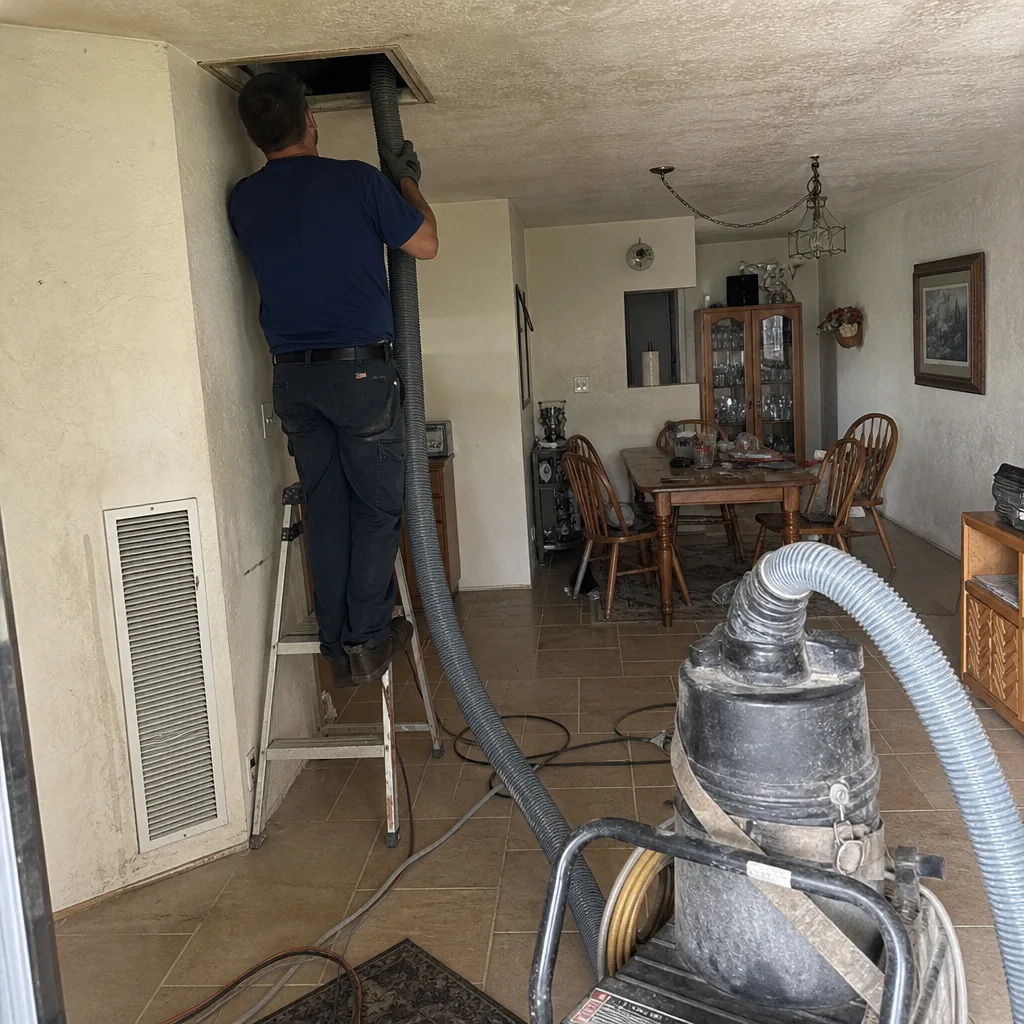 Before
 After
After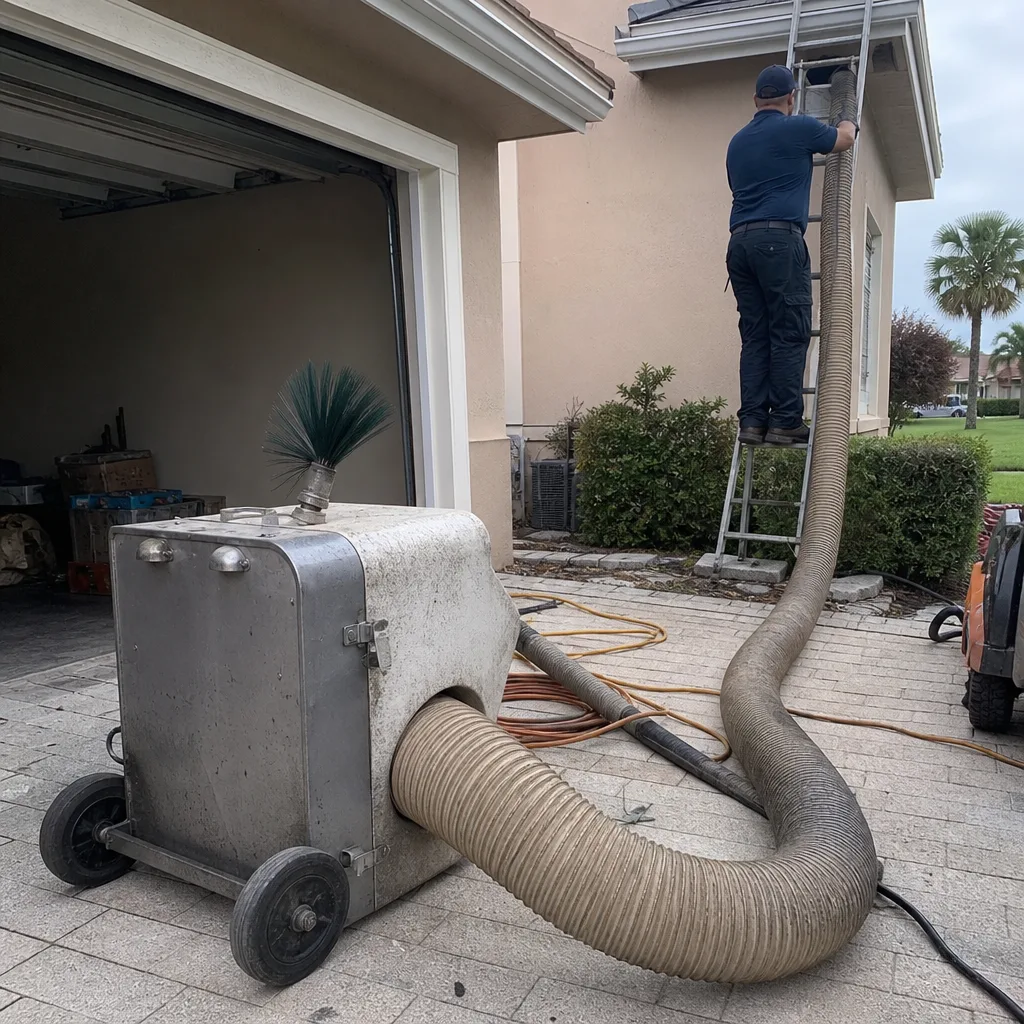 Before
 After
After